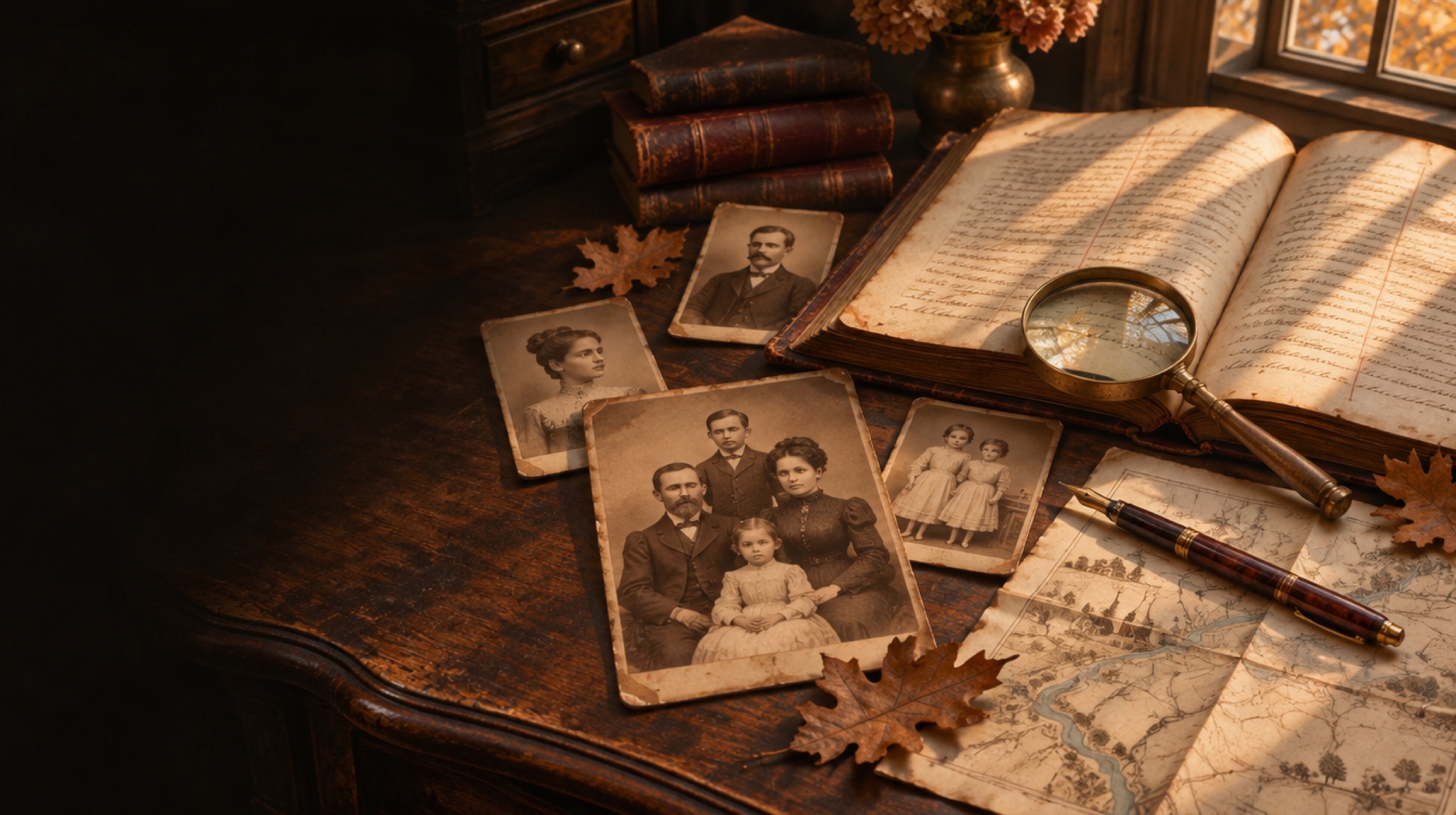
Your family history, researched and sourced

Tell us what you know about your parents and grandparents. We trace the rest in original records and send you an ancestor chart where every date, place and occupation cites its source.

From $150, paid once · Ready in about 2–3 weeks

  • Federal census
  • Vital records
  • Wills & probate
  • Pension files
  • Draft cards
  • City directories

A chart where every name has a paper trail

You get your ancestors laid out generation by generation, back to your great-great-grandparents or further. Each person on the chart carries what the records say about them.

  • Birth date and place
  • Death date and place
  • Occupation from census returns and directories
  • Military service when a record exists, with unit and dates
  • Sources for every fact, each graded for confidence
Open the full sample chart
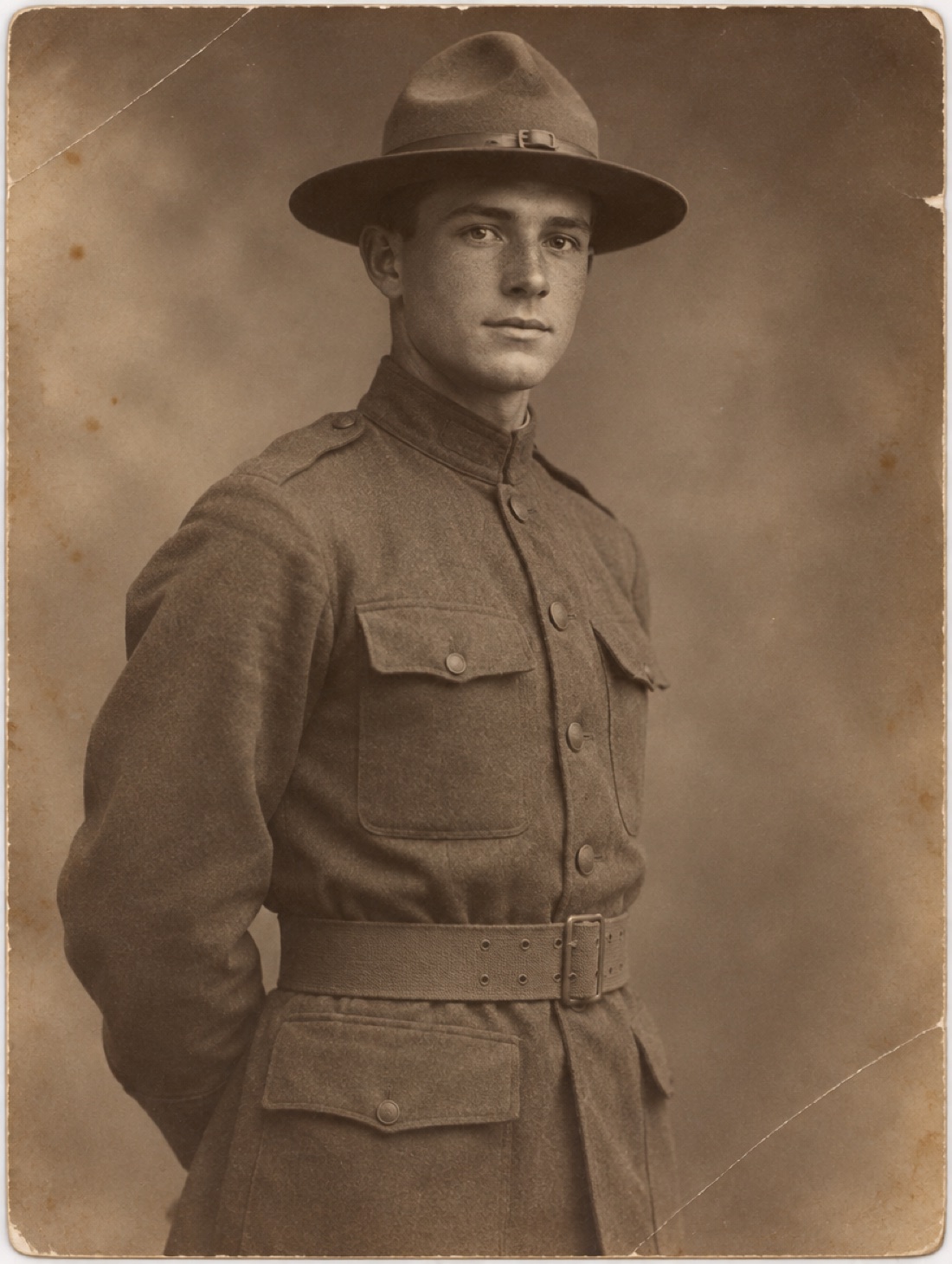
Illustrative sepia portrait of a young soldier in a World War I uniform

No. 10 · Great-grandfather, father’s side

Walter James Pruitt

Proven
Born
14 Mar 1896Banks County, Georgia
Died
2 Nov 1971Gainesville, Hall County, Georgia
Occupation
Rural mail carrier, U.S. Post Office
Military service
U.S. Army, World War I. Private, Company C, 325th Infantry, 82nd Division. Overseas May 1918 to May 1919.

Sources

  1. [1] WWI draft registration card, Banks County, Georgia, 5 Jun 1917
  2. [2] Georgia WWI service card, serial no. 1,893,442
  3. [3] 1900 U.S. census, Banks County, Georgia, ED 3, sheet 7A, dwelling 112

One record from our sample chart. The people and portraits shown on this site are fictional.

How it works

You do one short conversation. We do the weeks in the archive. Most charts are delivered two to three weeks after intake.

  1. Choose a package and pay

    Five generations or eight. One payment, nothing renews.

  2. Tell our intake assistant what you know

    A written conversation of about ten minutes: names, towns, rough years, family stories. “I don’t know” is a fine answer, and a common one.

  3. We research in original records

    Census returns, birth, marriage and death records, wills, land deeds and pension files. We start from what you told us and work back one generation at a time.

  4. Your chart arrives by email

    An interactive chart, a printable PDF and a full source report, usually two to three weeks after your intake.

Where the facts come from

We work from original records and images of them, not from other people’s family trees. These are the collections we search for every family.

A magnifying glass over a handwritten census ledger

Civil and census records

The census tells us who lived together, their ages, birthplaces and trades every ten years. Vital and court records pin down the dates and the relationships.

  • U.S. federal census1790–1950
  • State census returnswhere taken
  • Birth, marriage and death recordscounty & state
  • Wills, probate and estate filescounty courts
  • Land deeds and tax listscounty courts
  • City directories, newspapers, obituarieslocal
A bundle of old letters, a service medal and a soldier’s photograph on a desk

Military service

When an ancestor served, the record goes on the chart: branch, unit, rank and dates, and where they served when the file says. Pension files often name a wife, children and a home town, so they are among the best sources there are.

  • Revolutionary War pension and bounty-land files1775–1783
  • War of 1812 service and pension records1812–1815
  • Civil War service records, Union and Confederate1861–1865
  • Civil War pension applicationsfederal & state
  • World War I draft registration cards1917–1918
  • World War II draft registration cards1940–1947

We tell you what we could not prove

Family trees online are full of confident mistakes, copied from one tree to the next. Ours is built the other way round: nothing goes on your chart without a record, and we show our working.

Every link is graded

  • Proven Stated directly in original records that agree with each other.
  • Probable Strong indirect evidence and no record that contradicts it.
  • Speculative A reasonable lead, shown so you can see it. Not a conclusion.

Unverified claims are rejected in writing

If an online tree says something we can’t confirm, it doesn’t quietly slip onto your chart. It goes in the report as rejected, with the reason.

From the sample source report

John Wesley Whitfield was born in County Antrim, Ireland, in 1844.

Found in Several online trees, all copied from one unsourced original

Records say Every census from 1850 to 1910 gives his birthplace as Georgia

Rejected

When a line ends, we say where and why

A county courthouse burned. A mother is listed only as “unknown.” When the trail stops, the report names the last record, explains the gap, and lists the record that would most likely take that line further.

Empty boxes stay empty

An 8-generation chart has room for 255 people. No honest researcher fills every one. We would rather hand you a chart with gaps you can trust than a full one you can’t.

Two packages, one payment

No subscription and nothing to renew. Full refund any time before research begins.

Five Generations

You to your great-great-grandparents

$150 one-time

The people your grandparents remembered. Typically reaches the mid-1800s.

  • Ancestor chart, up to 31 people
  • Birth, marriage and death dates and places
  • Occupations from census and city directories
  • Military service where a record exists
  • A source for every fact, graded by confidence
Choose 5 generations

Eight Generations

Back to your fifth-great-grandparents

$695 one-time

As far as the paper trail runs. Often reaches the 1700s on well-documented lines.

  • Everything in Five Generations
  • Every line followed up to eight generations
  • Wills, land and pension files for early ancestors
  • A written note on where each line ends, and why
  • A list of the records that would take it further
Choose 8 generations

Questions people ask before they start

Something else? Write to hello@quillandroot.com and a researcher will answer.

What if you find very little?

Some families left a thick paper trail and some left almost none. We do the full search either way, and we report what exists: every record we found, every line we could not extend, and why. A short chart with honest notes is more useful than a long one with guesses in it.

Do you research living people?

No. Living relatives are not researched and are never published on a chart. If you tell us your parents’ names at intake, we use them only as a starting point for tracing the generations before them.

My ancestors came from outside the United States. Can you follow them?

U.S. records are our strength, and that is where most of the work happens. When a line crosses the ocean we follow it in overseas records that are available online, such as some British, Irish, German and Scandinavian registers. We can’t promise how far those lines will go, and the report will say where each one stops.

What about adoption or unknown parentage?

Records alone often can’t answer this. Adoption files are frequently sealed, and an unnamed parent rarely appears in documents. DNA testing is the right tool for that question. We will trace every line the records can support, and tell you plainly which ones they can’t.

How long does it take?

About two to three weeks from the day you finish your intake conversation. We email you when it’s ready.

What exactly do I receive?

An interactive chart you can open on any device, a printable PDF of the chart with a page for each ancestor, and a source list citing every record we relied on, including claims we checked and rejected.

Can I get a refund?

Yes, a full refund any time before research begins. Once a researcher has started on your family, the work is underway and we can’t refund it.

Do I need an Ancestry subscription or any account?

No. We use our own access to record collections. You don’t need a subscription, a DNA test or an account anywhere else.

Start with a name and a town

That is usually enough. Ten minutes of what you remember, and we will take it from there.